At the outset
The Three Names
The opening poem presents the naming of [Cats](entity:creature-recall-creature-cats-b2c04560ade4) as a matter that demands more than an ordinary household label. A cat has a familiar name used by the family, a more distinctive name, and a final, inward name that no human can discover.
During the daytime
Jennyanydots at Rest
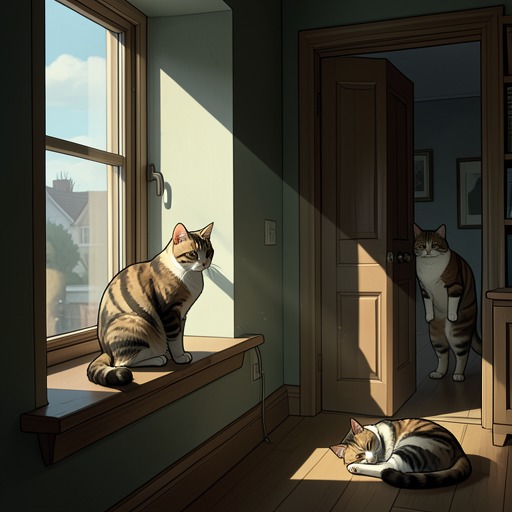
[Jennyanydots](entity:character-recall-character-jennyanydots-efe91c0967e6) spends the daylight hours sitting on stairs, mats, beds, and other comfortable places. Her stillness is so characteristic that it defines her as a [Gumbie Cat](entity:concept-recall-concept-gumbie-cat-772f9d7e7a99).
After the household sleeps
Lessons for the Mice
When the family has gone to bed, [Jennyanydots](entity:character-recall-character-jennyanydots-efe91c0967e6) turns her attention to the unruly [Mice](entity:creature-recall-creature-mice-f312214480dd) in the basement. She lines them up and tries to improve their manners by teaching them music, crocheting, and tatting.
On a later night
The Mouse Supper
Finding that lessons have not made the [Mice](entity:creature-recall-creature-mice-f312214480dd) quiet, [Jennyanydots](entity:character-recall-character-jennyanydots-efe91c0967e6) decides their behavior may come from an irregular diet. She prepares them a cake of bread and dried peas and a dish of bacon and cheese, applying domestic practicality to her nighttime work.
On another night
The Beetles' Troop
[Jennyanydots](entity:character-recall-character-jennyanydots-efe91c0967e6) concludes that the cockroaches need useful work to keep them from idleness. She organizes them into a disciplined troop of helpful boy-scouts and even creates a Beetles' Tattoo, extending her program of order beyond the [Mice](entity:creature-recall-creature-mice-f312214480dd).
Before the final night at Molesey
Growltiger's River Terror
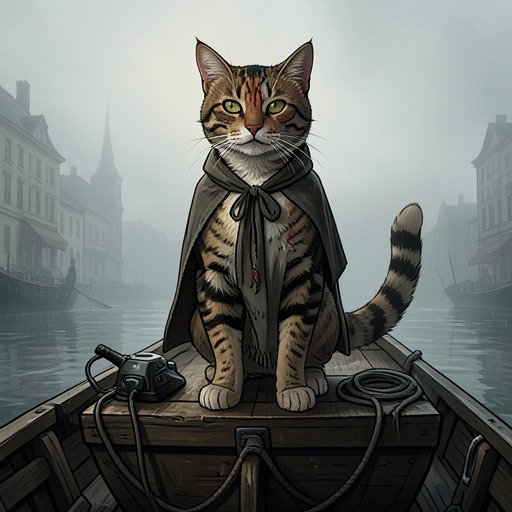
[Growltiger](entity:character-recall-character-growltiger-b07de075a57e) is introduced as a brutal prowler on the [River Thames](entity:location-recall-location-river-thames-81a7ec17b103), notorious from Gravesend to Oxford. His battered appearance and reputation make households fear for their animals whenever word spreads that he is loose.
During Growltiger's reign on the river
The Foreign Cats' Peril
[Growltiger](entity:character-recall-character-growltiger-b07de075a57e) reserves particular hatred for [Cats](entity:creature-recall-creature-cats-b2c04560ade4) of foreign name and race. The poem connects his missing ear to an earlier encounter with [Siamese Cats](entity:character-recall-character-siamese-cats-38e880ccb649), giving his prejudice a personal history while making his rule of the river still more dangerous.
On a summer night at Molesey
The Moonlit Duet
While [Growltiger’s barge](entity:object-recall-object-growltiger-s-barge-b137f2bf09fc) lies at [Molesey](entity:location-recall-location-molesey-85c2306ae553), he turns from his usual violence to court [Lady Griddlebone](entity:character-recall-character-lady-griddlebone-1b3f17a9264c). The two sing together beneath the moon, apparently absorbed in one another and unaware that bright eyes are watching from the water.
Later that same night
The Barge Ambush
[Siamese Cats](entity:character-recall-character-siamese-cats-38e880ccb649) close around the barge in sampans and junks, then swarm aboard at a signal. [Lady Griddlebone](entity:character-recall-character-lady-griddlebone-1b3f17a9264c) disappears during the attack, while [Growltiger](entity:character-recall-character-growltiger-b07de075a57e) is surrounded and forced to walk the plank.
At the end of the Molesey attack
Growltiger's Defeat
The feared river bully is driven to his death in the water, ending the career that had terrorized the riverbanks. News of his fall brings celebration in several places, turning his private defeat into a public release from fear.
In the next character portrait
The Tugger's Contrariness
[The Rum Tum Tugger](entity:character-recall-character-the-rum-tum-tugger-78b2985fd805) is presented as a creature of perpetual preference-shifting: he wants a flat when offered a house and a house when offered a flat, and he reverses his choice of prey just as readily. His habits make predictability impossible for the people around him.
During the same portrait
The Tugger's Domestic Mischief
[The Rum Tum Tugger](entity:character-recall-character-the-rum-tum-tugger-78b2985fd805) resists being let in, then demands to go out, and makes a fuss when confined in a drawer. He refuses offered food and affection on ordinary terms, yet leaps into a lap during sewing, making disruption the pleasure he consistently chooses.
Before the Jellicle Moon rises
The Jellicles Prepare
By morning and afternoon, the [Jellicle Cats](entity:character-recall-character-jellicle-cats-d5dd3675cfd7) are quiet, resting and saving their energy. As the moon approaches, they wash, groom themselves, and wait for the night when their reserved dancing powers can be put to use.
Under the Jellicle Moon
The Jellicle Ball
When the [Jellicle Moon](entity:time-recall-time-jellicle-moon-3edafe4c5f94) shines, the [Jellicle Cats](entity:character-recall-character-jellicle-cats-d5dd3675cfd7) gather for the [Jellicle Ball](entity:event-recall-event-jellicle-ball-c686fc09e73d). Their dancing and lively gathering reveal the joyous communal life that contrasts with their long hours of daytime repose.
During Mungojerrie and Rumpelteazer's time in Victoria Grove
The Burglars of Victoria Grove
[Mungojerrie and Rumpelteazer](entity:expression-recall-expression-mungojerrie-and-ru-1eeab39b91a1) build a reputation as nimble performers and accomplished burglars, using their home in [Victoria Grove](entity:location-recall-location-victoria-grove-ab7e6d16cac9) as a base for wandering and theft. Their visits leave households in disarray, with missing belongings and damage that residents attribute to one or both of them.
At a Sunday dinner
The Missing Sunday Dinner
As a family gathers for its Sunday meal, the cook reports that the joint has vanished from the oven. The family blames [Mungojerrie](entity:character-recall-character-mungojerrie-05122b5d95f6) or [Rumpelteazer](entity:character-recall-character-rumpelteazer-5ab49881eddb), adding a stolen dinner to the pair’s string of household depredations.
During a later household raid
The Double Cat Trick
When crashes and breakages erupt around a house, the family cannot tell whether [Mungojerrie](entity:character-recall-character-mungojerrie-05122b5d95f6) or [Rumpelteazer](entity:character-recall-character-rumpelteazer-5ab49881eddb) is responsible. The possibility that both are working together turns their partnership into the defining complication of their crimes.
Long before the village's present day
The Old Patriarch
[Old Deuteronomy](entity:character-recall-character-old-deuteronomy-3aade4323034) has lived for an extraordinary span, long enough to be famous in proverb and rhyme before [Queen Victoria's accession](entity:time-recall-time-queen-victoria-s-accessi-fafc997932cb). He has buried many wives, and his numerous descendants continue to prosper, making him a celebrated figure in the village.
On a market day
The Closed High Street
[Old Deuteronomy](entity:character-recall-character-old-deuteronomy-3aade4323034) settles in the High Street, and the ordinary business of the village yields to his rest. Traffic is turned aside and a road-closed notice goes up so that nothing disturbs him, while the Oldest Inhabitant recognizes the cause of the disruption.
During an afternoon at the Fox and French Horn
The Inn's Afternoon Quiet
[Old Deuteronomy](entity:character-recall-character-old-deuteronomy-3aade4323034) sleeps on the floor of the [Fox and French Horn](entity:location-recall-location-fox-and-french-horn-139b6ae5af51) while the men consider ordering another drink. The landlady sends them out by the back door rather than risk waking him, and the pub empties quietly to protect his repose.
After a quiet week
The Rival Dogs Meet
With the big Police Dog away from his beat, a Peke and a Pollicle encounter one another in the street. Neither advances nor retreats; their hostile staring and barking break the unusual calm and summon supporters from nearby homes.
Moments after the first barking
The Dogs Join the Fray
[Pekes](entity:character-recall-character-pekes-3eba8d1174e4) gather at windows and doors, while [Pollicles](entity:character-recall-character-pollicles-4516ab8efea7) assemble with their pipers and answer the challenge. [Pugs](entity:character-recall-character-pugs-fe497cd370a1) and [Poms](entity:character-recall-character-poms-9022c61f6481) also join in, and the growing din stops traffic, shakes the Underground, and frightens neighbors into calling for help.
At the height of the street battle
The Great Rumpuscat Appears
The [Great Rumpuscat](entity:character-recall-character-great-rumpuscat-da44923fc3f5) stalks out of a basement flat, his blazing eyes and enormous yawn confronting the assembled [Dogs](entity:creature-recall-creature-dogs-e0736038fb3e). His terrifying appearance and sudden leap scatter every combatant, leaving the street empty by the time the Police Dog returns.
During Mr. Mistoffelees's display
Mistoffelees' Disappearances
[Mr. Mistoffelees](entity:character-recall-character-mr-mistoffelees-e9f1e1dbe09d) demonstrates an uncanny command of tricks, cards, dice, and small objects. A knife or fork can vanish from view and turn up on the lawn much later, while his apparent presence in contradictory places strengthens his reputation as a conjurer.
Near the end of Mr. Mistoffelees's display
The Kittens from the Hat
[Mr. Mistoffelees](entity:character-recall-character-mr-mistoffelees-e9f1e1dbe09d) produces seven kittens from a hat, the most spectacular feat in a portrait built around impossible appearances. The stunt confirms the wonder of his magical reputation and leaves his admirers praising his cleverness.
Across Macavity's criminal career
Macavity's Empty Crime Scenes
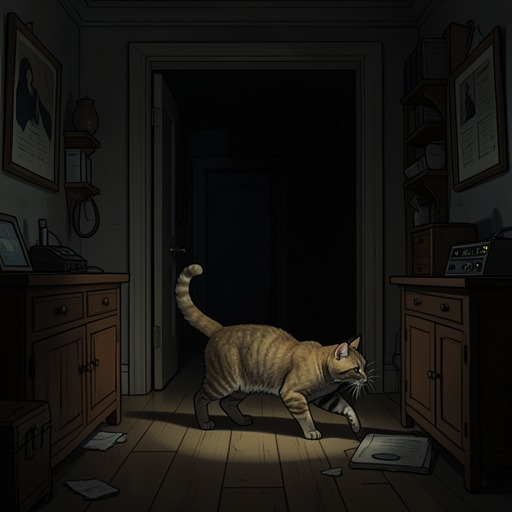
[Macavity](entity:character-recall-character-macavity-bc30874f2066) is blamed for an expanding range of crimes, from a looted larder and missing milk to broken glass and stolen jewels. Yet whenever investigators reach the scene, the ginger cat is nowhere to be found, defeating [Scotland Yard](entity:organization-recall-organization-scotland-yard-598725f8a130) and the Flying Squad alike.
During Macavity's later crimes
The Stolen State Papers
The thefts extend beyond private homes: a treaty disappears from the Foreign Office and plans go missing from the Admiralty. The Secret Service suspects [Macavity](entity:character-recall-character-macavity-bc30874f2066), but he is said to be miles away, resting or occupied with calculations and ready with an alibi.
As his wider influence is revealed
Macavity's Criminal Network
The poem suggests that notorious [Cats](entity:creature-recall-creature-cats-b2c04560ade4) such as [Mungojerrie](entity:character-recall-character-mungojerrie-05122b5d95f6) and [Lady Griddlebone](entity:character-recall-character-lady-griddlebone-1b3f17a9264c) may be agents acting for [Macavity](entity:character-recall-character-macavity-bc30874f2066). He emerges not merely as an elusive thief but as a hidden organizer who controls other criminals from behind the scenes.
In Gus's old age
Gus Remembers the Stage
[Gus](entity:character-recall-character-gus-71fc0dc9a8ed), whose full name is Asparagus, is now shabby, thin, and troubled by a shaking paw, but he remembers a time when he was a celebrated theatre performer. At the club behind the neighboring pub, he recounts his work with famous actors and his triumphs on the stage.
During Gus's reminiscences
Firefrorefiddle's Famous Part
Among the many roles [Gus](entity:character-recall-character-gus-71fc0dc9a8ed) claims to have played, his greatest creation was Firefrorefiddle, the Fiend of the Fell. He recalls performing across the theatre, from dramatic scenes to pantomime, and contrasts his trained generation with younger performers who, he believes, lack discipline.
Throughout Bustopher Jones's usual day
Bustopher's Club Circuit
[Bustopher Jones](entity:character-recall-character-bustopher-jones-ccace1c9bebe) moves between exclusive clubs around [St James's Street](entity:location-recall-location-st-james-s-street-18d5937f2db4), choosing meals according to the season and the venue. His routine of dining, drinking, and being greeted in white spats has made him a familiar figure in fashionable society.
By the time his routine is established
Bustopher's Expanding Girth
The repeated club meals have made Bustopher remarkably fat, though he insists that he is well preserved because he follows a settled routine. His confidence in lasting through his time is tied to the same comfortable habits that have made him unmistakably round.
At 11:39 on the Night Mail
Skimbleshanks Delays the Mail
The Night Mail is ready to depart, but the railway staff cannot find [Skimbleshanks](entity:character-recall-character-skimbleshanks-1b2224f78a4b) and believe the train cannot start without him. At 11:42 he appears from the luggage van, gives a flash of his eyes, and the signal clears for departure.
During the Night Mail's journey north
The Railway Cat's Patrol
[Skimbleshanks](entity:character-recall-character-skimbleshanks-1b2224f78a4b) supervises the train from the driver and guards to the passengers, pacing the corridor and inspecting the carriages. His watchful presence keeps the travelers quiet and ensures that nothing goes wrong aboard the Northern Mail.
During the passengers' night aboard
Skimbleshanks Guards the Berths
The passengers find orderly berths and the small conveniences of a well-kept sleeping car, while [Skimbleshanks](entity:character-recall-character-skimbleshanks-1b2224f78a4b) ensures that the guard remembers their needs. With the Railway Cat on watch, they can sleep without worrying about mice or disorder.
Through the night and into the later stops
Skimbleshanks at the Stations
While passengers sleep through some stations, [Skimbleshanks](entity:character-recall-character-skimbleshanks-1b2224f78a4b) remains active at Crewe and Carlisle and speaks with the police at Dumfries. At Gallowgate he helps passengers get out, then signals that they will meet again on the Midnight Mail.
At the close of the book
The Formal Cat Greeting
The final poem turns from the portraits to the question of how people should address [Cats](entity:creature-recall-creature-cats-b2c04560ade4). It rejects the easy familiarity appropriate to [Dogs](entity:creature-recall-creature-dogs-e0736038fb3e) and advises a respectful greeting, while allowing a more familiar salutation for a Cat already known to the speaker.
After the first formal greeting
Earning a Cat's Trust
A person seeking friendship with a Cat must offer tokens of esteem, such as cream or food suited to that Cat's taste. Respectful attention and patience may eventually earn the privilege of using the Cat's name, completing the book's portrait of proper human-Cat relations.